
Payroll in the UAE is much more than transferring salaries at the end of the month.
A reliable payroll process brings together employee master data, attendance, leave, salary changes, allowances, deductions, overtime, new joiners, leavers, pension requirements, payroll approvals, Wages Protection System (WPS) processing and post-payroll reconciliation.
For HR and payroll teams, even a small error can result in an incorrect salary, delayed payment, employee complaints or compliance issues.
This guide explains a practical end-to-end UAE payroll process that HR and payroll professionals can adapt to their organisation.
Important: Payroll policies differ between organisations. Internal cut-off dates, salary structures, approval workflows, allowances and payroll systems should always be checked against the employee’s contract, company policy and applicable UAE legislation.
UAE Payroll Process at a Glance
A typical monthly payroll cycle can be organised into the following stages:
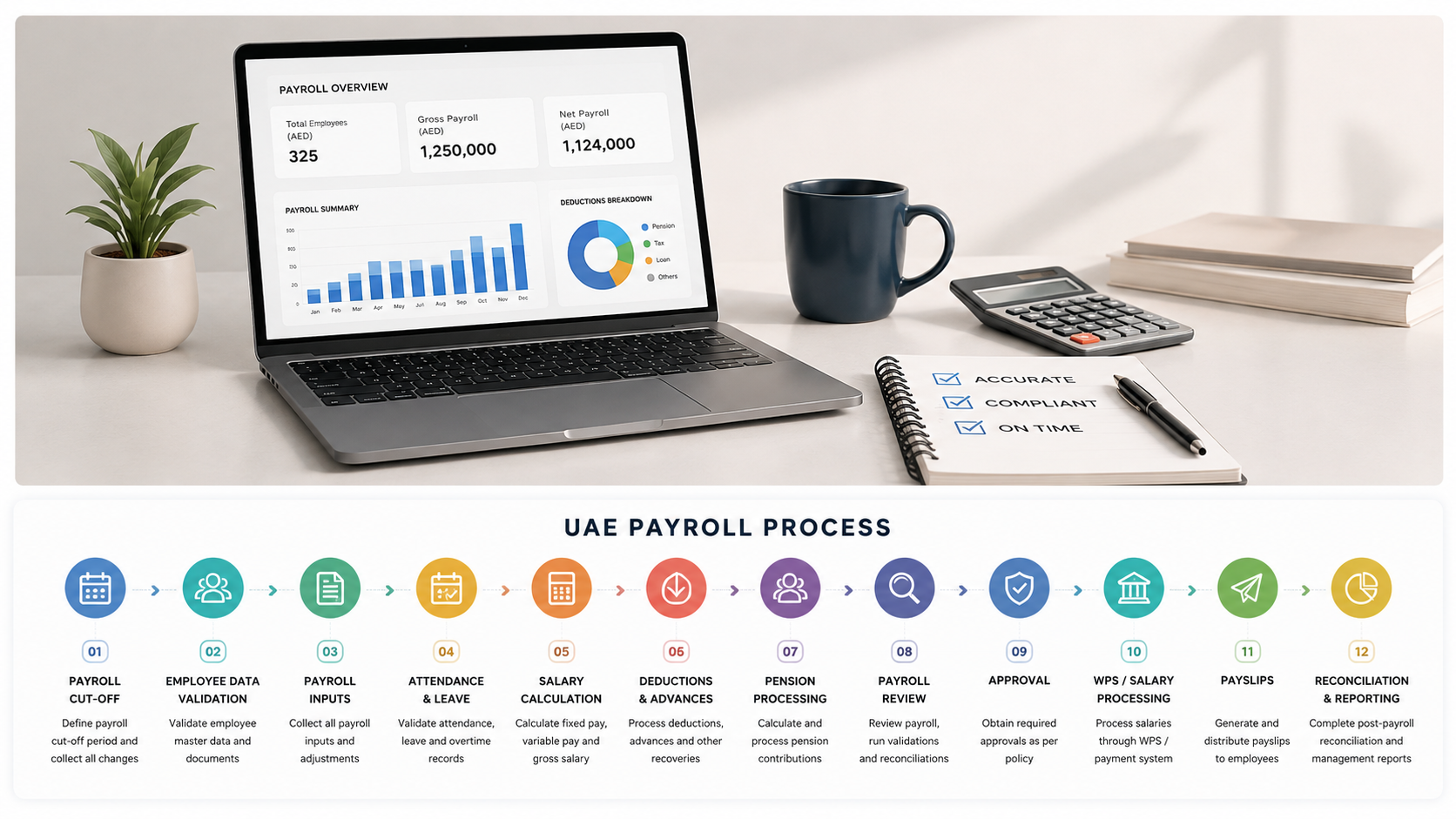
Payroll Cut-Off → Employee Data Validation → Payroll Inputs → Attendance & Leave → Salary Calculation → Variable Payments & Deductions → Pension → Payroll Review → Approval → WPS/Salary Processing → Payslips → Reconciliation
The exact workflow may differ depending on the organisation, but having a documented payroll calendar and clear responsibilities can significantly reduce payroll errors.
Step 1: Establish the Payroll Cut-Off Period
The first step is to define the period for which payroll inputs will be processed.
A payroll cut-off is an internal administrative deadline used by organisations to determine which changes will be included in the current payroll.
For example, a company might internally process attendance and payroll changes received up to the 20th of the month. Changes received after that date may be processed separately or carried forward to the next payroll, depending on company policy and whether doing so remains consistent with contractual and legal payment obligations.
Typical cut-off inputs include:
- New joiners
- Employee exits
- Attendance
- Annual leave
- Unpaid leave
- Overtime
- Incentives
- Bonuses
- Salary revisions
- Allowance changes
- Employee deductions
- Bank account changes
- Other payroll adjustments
The payroll team should communicate the cut-off calendar to HR, managers, Finance and other stakeholders well in advance.
Payroll Control: An internal payroll cut-off does not replace the employer’s obligation to pay wages when legally and contractually due.
Step 2: Validate Employee Master Data
Before calculating payroll, verify that employee information in the HRMS or payroll system is accurate.
Payroll calculations depend heavily on master data. Incorrect information can affect salary calculations, WPS processing, pension contributions, cost allocation and employee records.
Important employee data to validate:
- Employee ID and name
- Date of joining
- Employment status
- Basic salary
- Allowances
- Gross salary
- Bank account and IBAN
- Department and cost centre
- Work location
- Job title
- Labour contract information
- Nationality
- Pension eligibility, where applicable
- Last working date for leavers
Changes to sensitive payroll information should follow a documented approval process.
For example, a salary revision should not simply be changed in the payroll file based on an informal message. Payroll should verify the approved salary change and its effective date before processing it.
Step 3: Collect Monthly Payroll Inputs
Once master data is validated, collect all transactions affecting the month’s payroll.
This is one of the most important stages because incomplete inputs can result in underpayments or overpayments.
Employee movements
- New joiners
- Resignations
- Terminations
- Transfers
- Promotions
- Salary revisions
Attendance-related inputs
- Absence
- Unpaid leave
- Overtime
- Attendance adjustments
Variable payments
- Incentives
- Commissions
- Bonuses
- Overtime payments
- Reimbursements processed through payroll
- One-time allowances
Deductions
- Unpaid leave deductions
- Salary advances
- Loan recoveries
- Approved recoveries
- Other lawful deductions
A good payroll team maintains a monthly payroll input tracker showing the employee, transaction type, effective date, amount, approval status and payroll month.
Step 4: Validate Attendance and Leave
Attendance and leave can directly affect payroll, particularly when employees have unpaid absence, overtime or other attendance-related payments.
Before payroll is calculated, reconcile the attendance system with approved leave records.
Review:
- Present days
- Approved leave
- Unpaid leave
- Absences
- Overtime
- Public holidays where relevant
- New joiner attendance
- Last working dates
- Attendance corrections
Practical Example
Suppose the attendance report shows an employee absent for three days.
Before making a deduction, Payroll should determine whether those days were:
- Approved annual leave
- Sick leave
- Unpaid leave
- An attendance-recording error
- Another approved absence
Attendance status and payroll treatment are not always the same thing.
This is why attendance reconciliation should happen before payroll calculation.
Step 5: Process Leave Adjustments
Not every type of leave has the same payroll treatment.
The payroll team should identify the leave category and apply the correct contractual, policy and statutory treatment.
Common categories include:
- Annual leave
- Sick leave
- Maternity leave
- Parental leave
- Bereavement leave
- Study leave
- Unpaid leave
A frequent payroll mistake is treating every absence as unpaid leave before confirming the approved leave type.
Payroll should therefore use approved leave information rather than relying solely on raw attendance data.
Step 6: Calculate New Joiner Salaries
Employees joining during a payroll period may require a partial-month salary calculation.
Confirm:
- Joining date
- Contractual salary
- Effective payroll date
- Attendance
- Allowances
- Applicable company proration methodology
- Payments or deductions applicable from joining
Example
Assume an employee joins during the middle of the month with:
- Basic Salary: AED 6,000
- Allowances: AED 4,000
- Monthly Salary: AED 10,000
The employee’s first payroll may require proration.
However, organisations should not assume that one universal proration formula applies to every situation. The calculation should follow applicable legislation, the employment contract and the organisation’s approved payroll methodology.
Step 7: Process Leavers and Final Payroll
Employees leaving the organisation require additional checks because their final payroll can contain several components.
Depending on the circumstances, these may include:
- Salary up to the last working date
- Outstanding salary adjustments
- Leave-related payments
- Approved deductions
- Notice-related adjustments where applicable
- End-of-service benefits where applicable
- Other contractual entitlements
The payroll team should confirm the employee’s official last working date before finalising the calculation.
Final settlements should receive an independent review whenever possible because they are generally more complex than standard monthly payroll.
Step 8: Calculate Fixed Salary Components
Calculate the employee’s fixed earnings after attendance and employee movements have been validated.
These may include:
- Basic salary
- Housing allowance
- Transportation allowance
- Other contractual allowances
- Fixed monthly benefits paid through payroll
Payroll should distinguish between basic salary, allowances and total wage, because different statutory or contractual calculations may use different salary bases.
Step 9: Calculate Variable Earnings
Next, process approved variable payments.
Examples include:
- Overtime
- Commission
- Incentives
- Bonus
- Shift allowance
- One-time payments
- Other approved variable earnings
Every variable payment should have supporting documentation or an approved source.
A useful payroll control is to compare variable payments against the previous month and investigate unusually large changes.
Step 10: Process Payroll Deductions
Payroll deductions should be reviewed carefully before processing.
Examples may include:
- Unpaid leave
- Salary advances
- Employee loan repayments
- Pension contributions
- Approved recoveries
- Other deductions permitted under applicable rules
The payroll team should verify the reason, amount, authorisation and applicable requirements before processing a deduction.
Step 11: Process Pension Requirements
Pension is an important payroll consideration for eligible UAE and GCC nationals.
Payroll teams should determine the applicable pension authority, legislation, contribution salary and contribution rates rather than applying one standard percentage to every employee.
For UAE nationals, requirements may involve the General Pension and Social Security Authority (GPSSA) or another competent pension authority depending on the employee and jurisdiction.
For GCC nationals working in the UAE, applicable requirements can depend on the relevant GCC pension or social-security framework.
Pension reconciliation should include:
- Employee
- Applicable pension authority
- Contribution salary
- Employee contribution
- Employer contribution
- Effective date
- Monthly contribution
- Adjustments
Pension calculations should be reconciled before payroll approval.
Step 12: Prepare the Payroll Register
Once earnings and deductions have been calculated, prepare the payroll register.
A payroll register commonly includes:
- Employee ID
- Employee name
- Basic salary
- Allowances
- Gross earnings
- Variable earnings
- Deductions
- Pension
- Net salary
- Department
- Cost centre
- Relevant payment information
The exact fields depend on the organisation’s payroll system and reporting requirements.
Step 13: Perform Payroll Validation and Reconciliation
Never move directly from calculation to salary payment.
Payroll should first go through structured validation.
Headcount Reconciliation
Previous Month Headcount + New Joiners − Leavers = Expected Current Payroll Headcount
Investigate any difference.
Payroll Variance Analysis
Compare current-month payroll with the previous month.
Investigate significant movements caused by:
- New joiners
- Leavers
- Salary increases
- Bonuses
- Overtime
- Unpaid leave
- Incentives
- Corrections
- One-time payments
Net Salary Review
Look for:
- Zero salaries
- Negative salaries
- Unusually high salaries
- Unexpected reductions
- Duplicate employees
- Duplicate payments
- Employees missing from payroll
Bank Information Review
Check newly added or modified bank information before payment processing.
A maker-checker control or equivalent independent review is particularly valuable for sensitive employee and banking changes.
Step 14: Reconcile Payroll With Finance
Payroll and Finance should reconcile the payroll totals before salary processing.
Payroll costs may need to be allocated by:
- Company
- Department
- Cost centre
- Project
- Business unit
- Location
Any difference between the HR payroll register and Finance payroll records should be investigated before the payroll cycle is closed.
Step 15: Obtain Payroll Approval
Once payroll validation is complete, obtain approval according to the organisation’s authority matrix.
A typical workflow may look like:
Payroll Preparer → Payroll Reviewer → HR Approval → Finance Review → Authorised Final Approval
The actual workflow will differ by organisation.
The important principle is segregation of duties.
Where practical, the same person should not independently create employee data, calculate payroll, approve payroll and release salary payments without appropriate review controls.
Step 16: Process Salaries Through WPS
The Wages Protection System (WPS) is a core part of private-sector payroll compliance in the UAE for establishments and workers within its scope.
WPS facilitates wage payments through approved financial channels and enables the competent authorities to monitor wage payments.
Before WPS or salary submission, verify:
- Employee information
- Salary amounts
- WPS-related employee records
- Payment information
- Payroll period
- Total salary file value
- Employee count
- Exceptional or excluded cases
The payroll register and final salary-payment file should reconcile before submission.
For current regulatory requirements, always verify the latest guidance published by the Ministry of Human Resources and Emiratisation (MoHRE) and the UAE Government.
Step 17: Verify Salary Disbursement
Payroll responsibility does not end when the salary file is submitted.
After processing, review:
- Successful payments
- Rejected payments
- Invalid banking information
- Returned amounts
- Employees who did not receive salary
- WPS or payment exceptions
Rejected payments should be investigated promptly.
Step 18: Issue Payslips
After payroll has been finalised, employees should receive the appropriate salary statement or payslip according to the organisation’s process and applicable requirements.
A payslip commonly shows:
- Employee details
- Payroll month
- Basic salary
- Allowances
- Additional earnings
- Deductions
- Net salary
Payslips should be distributed securely because salary information is confidential.
Step 19: Complete Post-Payroll Reconciliation
A strong payroll process continues after salaries are paid.
Post-payroll activities may include:
- Confirming salary disbursement
- Reconciling rejected transactions
- Preparing accounting entries
- Reconciling payroll liabilities
- Reconciling pension
- Maintaining payroll records
- Resolving employee payroll queries
- Recording adjustments for the following payroll
- Preparing management reports
Document manual corrections made during the payroll cycle. This creates an audit trail and helps prevent recurring issues.
Monthly UAE Payroll Checklist
Employee Data
- New joiners included
- Leavers processed
- Salary revisions updated
- Employee master data checked
- Bank changes validated
Attendance & Leave
- Attendance reconciled
- Leave approved
- Unpaid leave checked
- Overtime approved
- Attendance discrepancies resolved
Payroll Calculation
- Fixed salary checked
- Variable earnings checked
- Deductions validated
- New joiners reviewed
- Leavers and final settlements reviewed
- Pension checked where applicable
Payroll Control
- Headcount reconciled
- Current vs previous month compared
- Payroll variance reviewed
- Duplicate payments checked
- Zero or negative salaries reviewed
- Net salary reviewed
- Finance totals reconciled
- Final approval obtained
Payment & Post-Payroll
- WPS/payment data validated
- Payroll and payment totals reconciled
- Payment submitted
- Rejections reviewed
- Payslips issued securely
- Pension reconciled
- Accounting entries prepared
- Adjustments recorded for next month
Common UAE Payroll Mistakes
1. Processing payroll without a clear cut-off
Late and untracked changes can create unnecessary adjustments and increase payroll risk.
2. Relying only on attendance data
An absence in an attendance system does not automatically mean an unpaid absence.
3. Missing new joiners
Poor coordination between recruitment, onboarding, HR operations and Payroll can result in employees being omitted.
4. Incorrectly processing leavers
Always verify the confirmed last working date and final-settlement information.
5. Using the wrong salary basis
Basic salary, allowances, gross salary and total wage should not automatically be treated as interchangeable.
6. Processing unsupported deductions
Every deduction should have a valid basis and comply with applicable requirements.
7. Failing to reconcile payroll
Even an automated payroll system can produce incorrect results when its inputs or configuration are wrong.
8. Ignoring rejected salary transactions
Submitting a salary file is not the same as confirming successful payment.
9. Weak controls over bank-account changes
Employee banking changes are sensitive and should be independently verified.
10. Depending entirely on uncontrolled spreadsheets
Excel is extremely useful for payroll reconciliation, but uncontrolled manual files can create formula, duplication, overwriting and version-control risks.
Recommended Monthly Payroll Workflow
- Close payroll inputs
- Collect attendance, leave and employee changes
- Validate employee master data
- Process new joiners and leavers
- Calculate fixed and variable earnings
- Process approved deductions
- Calculate pension where applicable
- Generate preliminary payroll
- Perform headcount and variance reconciliation
- Review exceptions
- Obtain approvals
- Prepare WPS/salary processing
- Release salary payment
- Verify successful disbursement
- Issue payslips
- Complete Finance and post-payroll reconciliation
Payroll Controls Every HR & Payroll Team Should Consider
Good payroll is not only about calculating the correct salary. It is also about having controls capable of detecting errors before employees are affected.
Consider implementing:
- Maker-checker controls
- Payroll variance analysis
- Headcount reconciliation
- New joiner and leaver reconciliation
- Bank-detail change verification
- Duplicate-payment checks
- Salary master vs payroll comparison
- Exception reports
- Access controls
- Payroll approval records
- Monthly payroll calendars
- Documented payroll SOPs
- Secure payroll-data storage
- Audit trails for manual adjustments
As an organisation grows, these controls become increasingly important.
Frequently Asked Questions
What is the payroll process in the UAE?
The UAE payroll process generally involves collecting employee and attendance data, calculating earnings and deductions, validating payroll, obtaining approvals, processing salary payments through the applicable payment mechanism including WPS where required, and completing post-payroll reconciliation.
What is WPS in UAE payroll?
WPS stands for Wages Protection System. It is the UAE’s electronic wage-payment framework used for establishments and workers within its scope, facilitating salary payments through approved financial channels and supporting regulatory monitoring of wage payments.
Is a payroll cut-off mandatory in the UAE?
A company’s internal payroll cut-off is primarily an administrative control. Organisations may establish cut-off dates to manage payroll inputs efficiently, but an internal cut-off does not override applicable contractual or statutory wage-payment obligations.
Should payroll be checked before salary payment?
Yes. Good payroll governance includes reconciliation and approval before salary release. Headcount, payroll variance, new joiners, leavers, deductions, bank changes and unusual payments should be reviewed.
Is payroll only the responsibility of HR?
Not necessarily. Payroll commonly requires coordination between HR, Payroll, Finance, employees, managers and authorised approvers. Responsibilities vary depending on the organisation.
Can Excel be used for UAE payroll?
Yes. Excel can be highly effective for payroll calculations, validation, reconciliation and reporting. However, organisations should maintain appropriate controls over formulas, access, version management, approvals and confidential employee information.
Final Thoughts
A successful UAE payroll process depends on three fundamental principles:
Accuracy. Compliance. Control.
Payroll teams should not simply ask:
Did we calculate the salary?
They should also ask:
Did we use the correct inputs?
Did we validate the changes?
Did we reconcile the payroll?
Was it properly approved?
Was the employee actually paid?
Can we explain and support every adjustment?
When these controls become part of the monthly payroll cycle, payroll moves beyond simple salary processing and becomes a reliable HR and financial control function.
For UAE HR and payroll professionals, a documented payroll calendar, standard input process, reconciliation framework and approval workflow can significantly improve payroll accuracy and reduce avoidable employee queries.
Official UAE Resources
For current regulatory requirements, refer directly to:
- UAE Government – Payment of Wages
- Ministry of Human Resources and Emiratisation – Wages Protection System
- Central Bank of the UAE – UAE Wages Protection System
- General Pension and Social Security Authority
Disclaimer: This guide is provided for general HR and payroll education and does not constitute legal advice. UAE employment, wage, pension and regulatory requirements may change. Always verify current requirements with the relevant official authority.