
Annual leave is one of the most common HR processes in the UAE, but administering it correctly involves more than simply deducting days from an employee’s leave balance.
HR teams regularly need to answer questions such as:
- When does an employee become entitled to annual leave?
- Is the entitlement 30 calendar days or 30 working days?
- What happens during the first year of employment?
- Can an employee take annual leave during probation?
- Who decides when annual leave is taken?
- What happens when a public holiday falls during annual leave?
- How much leave can be carried forward?
- Can unused leave be paid instead?
- What happens to unused leave when an employee resigns or is terminated?
- Which salary should be used when calculating unused leave at termination?
This guide explains the main UAE annual leave rules applicable to private-sector employees and provides a practical framework for HR teams administering leave.
Important: This guide focuses on employees covered by the UAE private-sector Labour Law. Different rules may apply to federal or local government employees, domestic workers and employees subject to other specific employment frameworks. Company policies and employment contracts may also provide benefits that are more favourable to the employee.
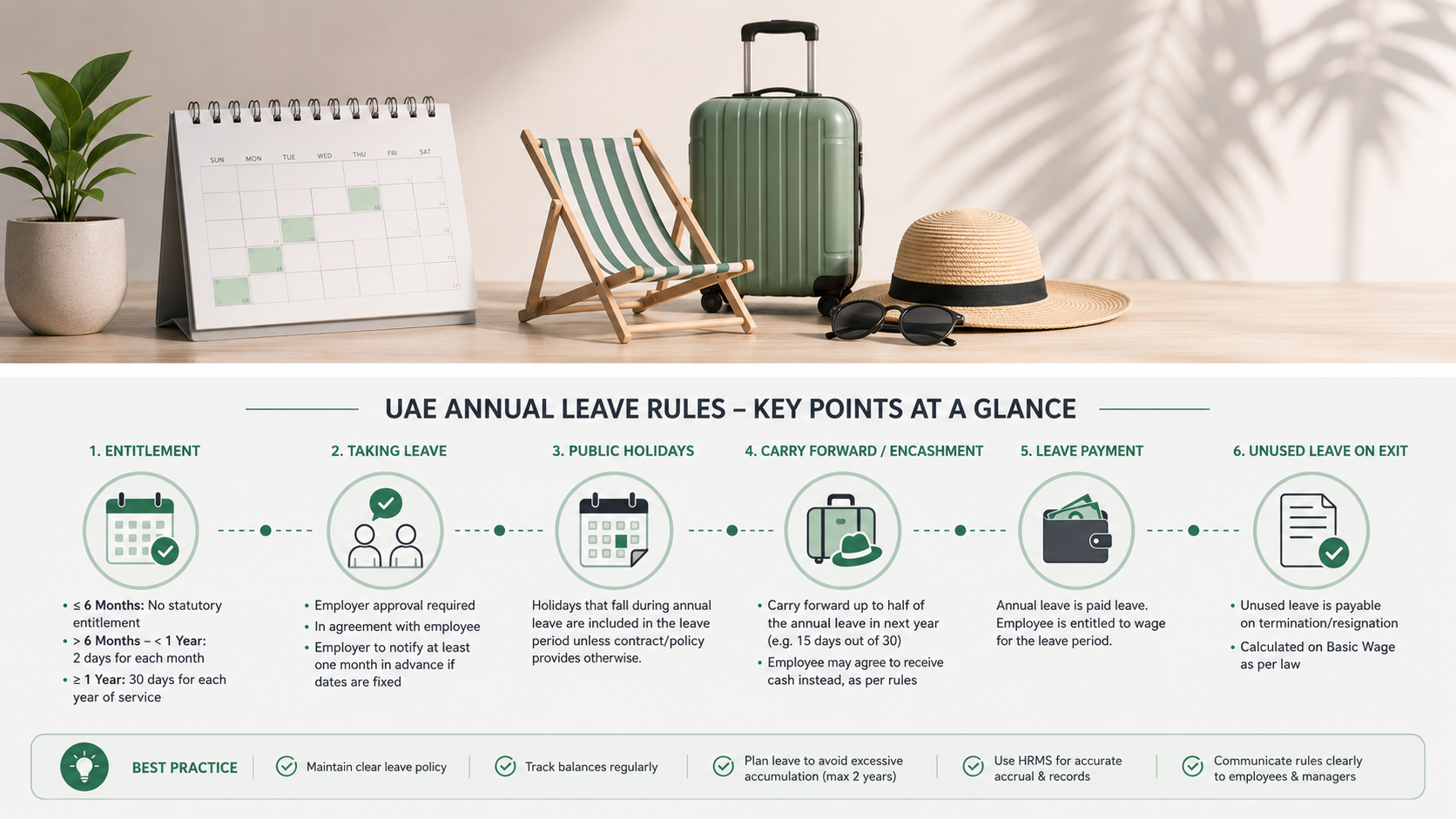
UAE Annual Leave Entitlement at a Glance
Under Article 29 of the UAE Labour Law, an employee is entitled to annual leave with full pay of at least:
| Length of Service | Annual Leave Entitlement |
|---|---|
| Up to 6 months | No statutory annual-leave entitlement under the standard accrual rule |
| More than 6 months but less than 1 year | 2 days for each month of service |
| 1 year or more | 30 days for each year of service |
The law also provides entitlement for the relevant part of the final year where employment ends before the employee has used the accrued balance.
This distinction is important for HR teams because an HR system may use a particular monthly accrual method as part of company policy, but that should not automatically be described as the statutory entitlement.
1. Annual Leave After Completing One Year
Once an employee has completed one year of service, the statutory entitlement is at least:
30 days of annual leave for each year of service.
This is the minimum entitlement under the UAE Labour Law for private-sector employees within its scope.
An organisation may provide a more favourable annual-leave entitlement through its employment contract or internal policy.
For example, a company may provide additional leave or calculate leave using a more favourable working-day system.
HR should therefore distinguish between:
Statutory entitlement
and
Company contractual entitlement
when configuring annual leave in the HRMS.
2. Annual Leave Between Six Months and One Year
Employees who have completed more than six months but less than one year of service are entitled to:
2 days of annual leave for each month of service.
Practical Example
Suppose an employee has completed 8 months of service.
Using the statutory rule:
8 months × 2 days = 16 days
However, HR should always check whether the organisation provides a more favourable entitlement under the employment contract or company leave policy.
3. What About the First Six Months?
This is an area where HR teams should be particularly careful.
Article 29 provides the two-days-per-month entitlement where an employee’s service is more than six months but less than one year.
Therefore, HR should not automatically tell employees:
“UAE Labour Law gives every employee 2.5 days of annual leave every month from their first day.”
A company can operate a more favourable leave-accrual policy or permit employees to take leave earlier.
The company’s HRMS accrual mechanism and the employee’s statutory entitlement should therefore not be confused.
4. Can an Employee Take Annual Leave During Probation?
Yes, it can be possible.
An employer may approve annual leave from the employee’s annual-leave balance during the probationary period.
The important point is that this is subject to employer approval. It should not be presented as an automatic right to take annual leave whenever requested during probation.
Recommended HR Practice
A clear probation leave policy should explain:
- Whether annual leave may be requested during probation
- Who approves the request
- Whether advance leave is permitted
- How the HRMS records the leave
- How the balance is treated if employment ends during probation
This helps prevent different managers from applying different rules.
5. Are the 30 Days Calendar Days or Working Days?
This is one of the most important practical distinctions in annual leave administration.
The statutory provision refers to 30 days, rather than defining the entitlement as 30 working days.
The law also provides that holidays prescribed by law or agreement that fall within annual leave generally form part of the annual-leave period unless the employment contract or establishment regulations provide something more favourable.
Therefore, HR should not automatically convert the statutory 30-day entitlement into 30 working days unless the organisation provides that more favourable benefit.
Example
If an organisation grants:
30 calendar days
the leave should be administered according to that basis.
If an employment contract instead provides:
30 working days
that represents a more favourable arrangement and the HRMS should be configured accordingly.
HR Control: Clearly state in the employment contract and leave policy whether annual leave is measured in calendar days or working days.
6. Who Decides When Annual Leave Is Taken?
Employees should normally take their annual leave in the year in which it becomes due.
However, the employer may determine leave dates according to work requirements, in agreement with the employee, or arrange leave on a rotational basis to maintain business continuity.
Where the employer determines the leave dates, the employee should be notified sufficiently in advance in accordance with the applicable requirements.
This means annual leave administration requires a balance between:
Employee leave entitlement
and
Business operational requirements
Recommended Leave Approval Workflow
Employee Request → Balance Check → Manager Review → Operational Coverage Check → Approval → HRMS Update
HR should maintain evidence of leave approvals and any subsequent changes or cancellations.
7. Can an Employer Keep Rejecting Annual Leave?
Employers have legitimate operational considerations when scheduling annual leave.
However, annual leave should not simply accumulate indefinitely because employees are continuously prevented from taking it.
The UAE Labour Law restricts an employer from preventing an employee from benefiting from accrued annual leave for more than two years, except where the employee chooses to carry it forward or receive cash compensation in accordance with the applicable rules.
HR Control
HR teams should actively monitor employees with:
- Large outstanding leave balances
- No annual leave taken during the year
- Balances approaching carry-forward limits
- Leave accumulated across multiple years
A simple leave dashboard can help HR identify these cases before they become a year-end problem.
8. What Salary Is Paid During Annual Leave?
Annual leave is paid leave.
An employee taking annual leave is entitled to the applicable wage for the annual-leave period.
However, this should not be confused with the calculation of unused annual leave when employment ends.
These are two different situations:
Taking annual leave while employed
is different from
Cash settlement of unused annual leave at termination
HR and payroll teams should ensure that the correct calculation method is applied to each situation.
9. What Happens When a Public Holiday Falls During Annual Leave?
This is another common source of misunderstanding.
Under the UAE Labour Law, public holidays prescribed by law or agreement that fall during an employee’s annual leave generally form part of the annual-leave period.
In other words, a public holiday does not automatically extend annual leave.
However, the employment contract or company regulations may provide a more favourable arrangement.
Practical Example
Suppose an employee is already on approved annual leave when a UAE public holiday occurs.
HR should check:
- The statutory rule
- The employment contract
- The company’s leave policy
If the company’s policy provides the public-holiday day back to the employee, the more favourable company arrangement should be followed.
10. Can Annual Leave Be Carried Forward?
Yes, subject to the applicable rules.
The UAE Executive Regulations provide that an employee may carry forward not more than half of the annual leave entitlement to the following year, subject to the applicable requirements.
For an annual entitlement of 30 days:
Maximum standard carry-forward = 15 days
An employee may also agree with the employer to receive cash compensation instead, subject to the applicable rules.
Example
Annual entitlement: 30 days
Unused balance: 20 days
Standard carry-forward ceiling:
15 days
The remaining balance should be handled according to the applicable legal requirements and company policy.
HR Control: Avoid configuring unlimited automatic carry-forward without reviewing the organisation’s legal and contractual framework.
11. Can Annual Leave Be Encashed Instead of Taken?
Yes, in circumstances permitted under the applicable rules.
An employee may agree with the employer to receive a cash allowance instead of carrying forward the permitted leave balance.
The applicable calculation should follow the requirements governing leave compensation at that point.
However, HR should distinguish this situation from unused annual leave paid when employment terminates.
They are not necessarily the same calculation.
12. What Happens to Unused Annual Leave When Employment Ends?
When an employee resigns or otherwise leaves employment with legally due unused annual leave, the outstanding entitlement should be included in the final-settlement process.
An important distinction applies here.
For termination-related unused annual leave, the applicable statutory cash allowance is calculated according to the employee’s basic wage.
Practical Example
Assume:
Basic Salary: AED 6,000
Total Monthly Salary: AED 10,000
Unused Annual Leave: 10 days
HR should not automatically calculate the statutory termination leave settlement using the AED 10,000 total monthly salary.
For legally due unused annual leave at termination, the applicable statutory calculation basis is the employee’s basic wage.
The calculation should be documented and reviewed as part of the employee’s final settlement.
13. Annual Leave for Part-Time Employees
Part-time employees are also entitled to annual leave, but their calculation differs from the standard full-time entitlement.
The entitlement is determined according to the applicable working-hours calculation under the Executive Regulations.
HR teams should therefore avoid automatically applying the standard full-time annual-leave configuration to every part-time employee.
HRMS Control
Employment type should be one of the fields used when determining:
- Annual entitlement
- Accrual method
- Working hours
- Leave deduction
- Leave balance
14. Annual Leave and Sick Leave
Annual leave and sick leave are separate statutory leave categories.
If an employee becomes sick while already on annual leave, HR should not automatically convert the annual-leave period into sick leave without reviewing the circumstances.
A controlled process would be:
Employee Notification → Medical Documentation → HR Review → Legal/Policy Check → HRMS Adjustment if Applicable
This topic should also be addressed in the organisation’s leave policy.
15. Annual Leave and Unpaid Leave Are Different
Annual leave is a statutory paid entitlement.
Unpaid leave is a separate leave category and can have different consequences for payroll, benefits, attendance and other employment calculations.
HR systems should maintain separate leave codes such as:
AL — Annual Leave
UL — Unpaid Leave
Mixing these categories can create errors in:
- Leave balances
- Payroll
- Attendance
- Employee records
- HR reporting
- Final settlement
Practical Annual Leave Examples
Example 1 — Employee With 14 Months of Service
An employee has completed more than one full year of employment.
The employee is entitled to the applicable annual-leave entitlement for the completed year, with the subsequent period administered according to the statutory and company accrual framework.
The employee should not simply be treated as a new employee because a new calendar year has started.
Example 2 — Employee With 8 Months of Service
The employee has completed more than six months but less than one year.
Statutory entitlement:
8 months × 2 days = 16 days
subject to any more favourable contractual or company entitlement.
Example 3 — Public Holiday During Annual Leave
An employee’s approved annual leave overlaps with an official UAE public holiday.
The public holiday generally forms part of the annual-leave period unless the employment contract or company regulations provide a more favourable arrangement.
Example 4 — Carrying Forward Leave
Annual entitlement:
30 days
Unused leave:
12 days
Because 12 days is below half of the 30-day annual entitlement, it falls within the standard 15-day carry-forward ceiling, subject to the applicable requirements.
Example 5 — Employee Leaves With Unused Annual Leave
An employee resigns with a legally due unused annual-leave balance.
HR should:
- Confirm the employee’s last working date
- Reconcile annual leave earned
- Deduct annual leave already taken
- Determine the legally due unused balance
- Calculate the applicable cash allowance
- Include it in the final settlement
- Retain the supporting calculation
For termination-related statutory unused leave, the applicable calculation basis is the employee’s basic wage.
Annual Leave Checklist for HR Teams
Employee Eligibility
- Confirm date of joining
- Confirm length of service
- Check employment type
- Verify contractual leave entitlement
- Identify statutory versus company entitlement
Leave Request
- Check available balance
- Confirm requested dates
- Obtain manager approval
- Check operational coverage
- Record approval
- Update HRMS
Before Leave
- Confirm approved dates
- Review attendance records
- Notify payroll where necessary
- Confirm any required handover
- Update the employee leave calendar
Year-End Review
- Review unused balances
- Identify carry-forward balances
- Apply applicable limits
- Identify excessive outstanding leave
- Communicate with employees and managers
- Document approved exceptions
Employee Exit
- Confirm last working date
- Verify leave already taken
- Reconcile leave balance
- Identify legally due unused leave
- Apply the correct salary basis
- Include the amount in final settlement
- Retain the supporting calculation
Common Annual Leave Mistakes HR Should Avoid
1. Automatically Giving Everyone 2.5 Days From Day One
A company’s HRMS may accrue leave this way, but HR should distinguish company accrual practice from the statutory wording governing annual-leave entitlement.
2. Treating 30 Days as 30 Working Days Without Checking
The statutory entitlement is expressed as 30 days.
A company providing 30 working days may be offering a more favourable contractual benefit.
3. Automatically Adding Public Holidays to Annual Leave
Public holidays occurring during annual leave generally form part of the annual-leave period unless a more favourable contractual or company rule applies.
4. Using Total Salary for Termination Leave Encashment
The statutory termination cash allowance for legally due unused annual leave is based on the employee’s basic wage.
5. Allowing Unlimited Leave Accumulation Without Review
Carry-forward and accumulated balances should be actively monitored against applicable legal requirements and company policy.
6. Treating Annual Leave and Unpaid Leave as the Same
They are separate leave categories and should have different HRMS and payroll treatments.
7. Maintaining Leave Only in Excel Without Reconciliation
Excel can be an excellent leave-management and reconciliation tool, but balances should reconcile with the organisation’s official HR and payroll records.
Recommended Annual Leave Workflow
Normal Leave Process
Employee Request → Balance Check → Manager Approval → HR Validation → HRMS Update → Payroll Impact Check → Leave Taken → Attendance Reconciliation → Balance Update
Year-End Process
Leave Balance Review → Carry-Forward Assessment → Employee/Manager Communication → HRMS Update → Reconciliation
Employee Exit
Last Working Date → Leave Reconciliation → Unused Entitlement → Leave Encashment Calculation → Final Settlement Review
Annual Leave Controls Every HR Team Should Consider
A strong annual-leave process should include:
- Clear annual-leave policy
- Defined calendar-day or working-day basis
- Controlled leave accrual
- Manager approval workflow
- HR validation
- Negative-balance controls
- Carry-forward controls
- Year-end leave reconciliation
- Public-holiday configuration
- Probation leave rules
- Part-time employee configuration
- Leaver balance reconciliation
- Final-settlement review
- Audit trail for manual adjustments
Leave balances ultimately affect both employees and financial liabilities, so they should be treated as controlled HR data rather than simply an attendance record.
Frequently Asked Questions
How many annual leave days are employees entitled to in the UAE?
For private-sector employees within the scope of the UAE Labour Law, the statutory entitlement is at least 30 days for each year of service after completing one year.
Employees with more than six months but less than one year of service are entitled to 2 days for each month of service.
Can an employee take annual leave during probation in the UAE?
It can be possible. The employer may approve annual leave during the probationary period from the employee’s annual-leave balance.
Is UAE annual leave 30 calendar days or 30 working days?
The statutory provision provides 30 days rather than 30 working days.
Employers may provide a more favourable working-day entitlement through the employment contract or company policy.
Can annual leave be carried forward?
Yes.
Under the Executive Regulations, an employee may generally carry forward not more than half of the annual leave entitlement to the following year, subject to the applicable requirements.
For a 30-day annual entitlement, this would ordinarily mean up to 15 days.
Can an employer refuse annual leave?
Employers can manage annual-leave scheduling according to operational requirements and the applicable legal framework.
However, employees should not continuously be prevented from benefiting from accrued annual leave contrary to the statutory requirements.
What happens to unused annual leave when an employee resigns?
Legally due unused annual leave should be included in the employee’s final settlement.
For termination-related statutory unused annual leave, the applicable cash allowance is calculated according to the employee’s basic wage.
Do UAE public holidays extend annual leave?
Not automatically.
Public holidays occurring during annual leave generally form part of the annual-leave period unless the employment contract or company regulations provide a more favourable arrangement.
Final Thoughts
Annual leave administration is more than maintaining a leave balance.
A reliable HR process needs to answer four questions correctly:
What is the employee entitled to?
How much leave has been earned and used?
What rules apply when leave is carried forward?
What balance must be settled when employment ends?
For HR teams, one of the biggest risks is often not the leave rule itself but the gap between the:
Employment Contract → Company Policy → HRMS Configuration → Attendance Records → Actual HR Practice
Those elements should tell the same story.
When annual-leave rules are documented clearly and leave balances are reconciled regularly, organisations can reduce employee disputes, payroll corrections, incorrect final settlements and year-end leave-balance problems.
Official UAE Resources
For current annual-leave requirements, HR professionals should refer to:
- UAE Labour Law — Federal Decree-Law No. 33 of 2021, particularly Article 29
- Executive Regulations of the UAE Labour Law
- UAE Government annual leave guidance
- Ministry of Human Resources and Emiratisation (MoHRE) guidance
Always check the latest official legislation and regulatory guidance when applying these rules to a specific employment situation.
Disclaimer: This article is provided for general HR education and does not constitute legal advice. Employment circumstances and applicable regulatory frameworks can differ. Always verify current requirements with MoHRE, UAE Legislation and the relevant competent authority.